2.26.2012

The Man in Black

"Ah, I'd love to wear a rainbow every day,
And tell the world that everything's OK,
But I'll try to carry off a little darkness on my back,
'Till things are brighter, I'm the Man In Black."
                             -Johnny Cash, lyrics from Man in Black

"Hello, I'm Johnny Cash," were the famous, self-introductory words uttered by the "man in black" himself at the start of his shows. Johnny Cash, born on February 26, 1932 in Arkansas, would have turned 80 years old today. Famous for his prison-themed tunes that often had rhythms resembling a train puffing down the track, he was also known for his signature color: black.

Johnny Cash outside of Folsom Prison
Cash initially wore black out of convenience so he and his band members would match the first time they performed at a Memphis church. Years later, in a decade where flashy colors were popular in both street fashion and the country music world, Cash released the album Man in Black and clothed himself in the dark hue from head to toe. "Everybody was wearing rhinestones, all those sparkle clothes and cowboy boots," he said. "I decided to wear a black shirt and pants and see if I could get by with it. I did and I've worn black clothes ever since." According to the song's lyrics, his reasons for wearing black were many - "for the poor and beaten down," "for the prisoner who has long paid for his crime," and "for those who never read, or listened to the words that Jesus said." It was also released during the Vietnam War, giving Cash another reason to wear the color associated with mourning.

Manuel Cuevas, who has designed stage clothing for legendary country and rock 'n' roll performers such as Elvis and Bob Dylan, kept Cash looking cool by outfitting him in his go-to "uniform." "There's nothing flamboyant about Johnny Cash in his black suits," Cuevas said. "That's a man who had a charisma and who could fill up a room with his presence." Cash's stage attire may have been a fashion risk at the time, but it worked then and would even be considered fashionable today.

The "man in black" was also known for his prison fixation. He performed at Folsom and San Quentin State Prisons in the late 60s. Clad in a three-piece black suit with skinny pants (something a modern day hipster would pay good money for), Cash lit up the stage at Folsom while the prisoners enthusiastically clapped along and cheered, particularly when he sang about the misdeeds that landed some of them in the slammer. He even performed an original song written by one of the inmates, Glen Sherley. Cash wrote in his autobiography, "I've always thought it ironic that it was a prison concert, with me and the convicts getting along just as fellow rebels, outsiders, and miscreants should, that pumped up my marketability to the point where ABC thought I was respectable enough to have a weekly network TV show." Although Cash confidently sang "I got stripes, stripes around my shoulders" and about being "stuck in Folsom Prison," he never spent more than one night at a time in jail.

In honor of Johnny Cash, I made a black top and a "prison-striped" skirt. The black and white stripes are very subtle, so I embellished the fabric by sewing black ribbon on to create an interesting diamond pattern. I applaud Johnny Cash for his fashion sense and color choice. Black is timeless. He summed it up by singing, "Up front there ought 'a be a Man In Black."


MADE IN KANSAS

2.12.2012

NY Fashion Week - Part 1

"Every generation laughs at the old fashions, but follows religiously the new."
                                           -Henry David Thoreau

Fashion shows have been around for decades. The first one in the U.S. took place in 1903 at a store in New York called Ehrich Brothers. Since then, there have been a multitude of runway events all around the world and, most famously, in New York, London, Milan, and Paris.

The first New York Fashion Week, then referred to as "Press Week," was started by publicist Eleanor Lambert in 1943. Those in the fashion industry were unable to attend the Paris runway shows that year because of World War II, so Lambert established "Press Week" to showcase American designers. It was a huge success and magazines such as Vogue started giving more credit to American designs rather than strictly focusing on French fashions.

The Sarasota Herald-Tribune published an article on July 23, 1943, written by Dorothy Roe, about the world's first fashion week that stated, "Dresses priced from $3.95 to $395 were included in the big parade of fall styles representing a complete cross-section of the vast New York dress industry, which turns out the clothes worn on America's main streets as well as Fifth avenue." $3.95 . . . can you imagine? Despite the economic hardships and war rationing, designers managed to make the best of their resources in 1943. Roe wrote, "Strict economy of cut is the theme of wartime fashion as interpreted in this week's showings. But ingenious details, startling design and clean, streamlined silhouettes establish the slim, fabric-saving styles as the authentic trend of the times rather than a wartime necessity."

New York Fashion Week has grown a lot since 1943. Over 100,000 guests are expected to attend this week. The runway shows began Thursday morning and will continue through next Thursday. Among the lineup of designers to debut their fall 2012 collections are Betsey Johnson, Michael Kors, Vera Wang, Diane Von Furstenberg, Anna Sui, and Calvin Klein.

With all this talk of fall collections, I made a top that will be perfect for autumn. It's identical to one I did several months ago. I even used the same fabric, but chose a different color scheme. Unfortunately, it will only be debuting at Kansas Fashion Week.


MADE IN KANSAS

2.05.2012

Star Designs

“I don't expect to fit in right away but I do sense that the fashion world is rooting for me, too. I'm not being treated like a celebrity wannabe fashion designer. But even if I was, it doesn't really matter because I'm doing this for me ... but it does feel really good when you have a hit.”
                                                               -Gwen Stefani

More than ever before, Hollywood is full of actors turned singers turned fashion designers who have a fragrance, clothing line, or both,  and it almost seems farcical. All laughing aside, there are a select few who are passionately involved in what they tag their name onto and take their businesses seriously. Among those few are Katie Holmes, Jeanne Yang, and Gwen Stefani.

Katie Holmes and stylist Jeanne Yang realized they both enjoyed sewing as a hobby and collaborated to form Holmes & Yang, a women's clothing collection. Yang said, "It’s so rare, unfortunately, that I actually know people who are into crafting and doing stuff like that." They design sophisticated clothes with a few simple priorities: use luxurious fabrics, design to fit perfectly, pay careful attention to detail, and have everything made close to home in the USA. One of my favorite items from Holmes & Yang is a beautifully-crafted, trimmed trench coat available at Barneys New York. It is structured, has just the right amount of detail, and would look flattering on any woman. Katie spoke of the versatility of the collection when saying, "We just wanted to do comfortable clothes that you can wear going from a meeting to being a mom to going on a date." What more could a girl ask for?

L.A.M.B. is Gwen Stefani's clothing line inspired by her own personal style- a mix of old Hollywood glamour and modern street wear. You might call it rocker chic. L.A.M.B. designs are sold in many stores around the world including a few in Kansas. Like Holmes and Yang, Stefani has a past history of sewing. She said, "I'd peg the pants and cut the shirts. My room was always a sewing disaster. I'm not a great technical sewer but I had the ideas. I'd use Velcro instead of zippers because they were easier to do."

It has been unseasonably warm in Kansas this winter and it almost feels like spring. The mild weather inspired me to make a reversible tank and pleated poplin skirt. I far prefer spring and summer clothing to cold-weather attire, so I'm excited to create more summer looks in the upcoming months.


MADE IN KANSAS


1.29.2012

And the Oscar Goes to . . .

"I would love to dress everyone...but what all these actresses this year have in common is great style, lots of personality and that star quality that makes the red carpet come alive."
                                                               -Donatella Versace

With the People's Choice Awards and the Golden Globes just behind us, Oscar nominations announced on Tuesday, and the Screen Actors Guild Awards tonight, the awards season is upon us. The red-carpet, star-studded nights are almost as important to fashion designers as the actors being acknowledged. Every top designer has one goal at this time of year: to dress an A-list celebrity for one of these glitzy affairs.

The Academy Awards began in 1929 and, despite all the glamour now, there was a time when some of the leading actors in Hollywood shunned the ceremony. According to Bronwyn Cosgrave, fashion historian and author of the book Made for Each Other: Fashion and the Academy Awards, "It wasn't cool--it was an obligation. Louis B. Mayer and Adolph Zukor had to twist arms. The chic women didn't go. Hollywood bred rebels in the 20s and 30s who didn't want to hang out with V.I.P.s in penguin suits." Over time, the Oscars did gain popularity among celebrities and the public with a big emphasis placed on fashion.

In 1954, Audrey Hepburn, who had impeccable personal style, was outfitted by Givenchy for the Academy Awards. She glowed in a pretty white floral dress as she accepted her award for Best Actress in Roman Holiday. Four years later in 1958, an article was published in the New York Times titled, "Film Queens Win 'Oscars' for Fashions." The piece included tidbits about the last-minute fashion decisions of Mae West and Zsa Zsa Gabor and how that impacted a radio report of the ceremony. It also stated that, "The Academy hinted to all who participated that extremely low dresses were not welcome." It went on to say that there was a few feet of tulle available that night just in case any of the necklines "had to be built up at the last minute." I highly doubt Hollywood starlets would go for that today, but it's funny to think about. 

I didn't watch the Golden Globes this year, but I saw pictures and became obsessed with the Atelier Versace gown worn by Angelina Jolie. It was stunning. I decided to make an every day top similar to the Versace dress, so I rummaged through my scraps and found the perfect red and ivory fabrics. I also made a skirt using a homespun cotton and sewed piping along the bottom to tie in the red accent on the top. I'm not a big fan of the "looks for less" often seen in magazines because they never look as good as the original design, but this would definitely be classified as my "look for less."


MADE IN KANSAS

1.22.2012

Back to the Jazz Age

"Let us keep up the rules that flapperism is composed of--bobbed hair, short skirts and low-heeled shoes, giving the body plenty of room to expand itself and that free and easy swing that only a short skirt can afford. What do you say flappers?"
       -Excerpt from a letter published in The Flapper magazine (1922) written by a Chicago flapper

Photograph of
my grandma in 1926
Jazz music, dancing, speakeasies, gansters, and, of course, flappers were all part of the twenties underground scene. The flapper emerged as the new, fancy-free woman of the decade with a carefree attitude and flare for style. She didn't care about the societal rules imposed on women and still kept her femininity while keeping up with the men. Flappers became such a sensation that there was even a magazine devoted to them called The Flapper, which embraced the same free spirit outlook as its readers and included the byline, "Not for Old Fogies." When Paris fashion tried to "impose" the long skirt on America in 1922, The Flapper was outraged and included the following at the end of an article titled, "Flappers Protest Dictation From Paris."

     Any flapper reader of The Flapper magazine may fill out the following blank and mail it in as a token of her stand on Parisian dictation of styles. No names will be used; our only concern is to arrive at an accurate gauge of flapper opinion. Results of this referendum will be published in the November issue.
.............................................................................................................
The Flapper, 604 Ogden Bldg., Chicago, Ill.
     Gentlemen: This is how I stand on continuation of present-day
styles. I am marking my preference with an X.
                                                    For      Against
          Bobbed Hair              ____      ____
          Rolled Sox                 ____      ____
          Short Skirts               ____      ____
          Knickers                    ____      ____
          Low-heeled Shoes    ____      ____
          Corsets                     ____      ____
Name............................................. Age.............
Street Address............................ City.............

Photograph of
my grandma in the 1920s
By the twenties, women were tired of wearing uncomfortable, stuffy clothing and were ready for a change. The loose fitting, drop-waist dresses became a staple in every flapper's wardrobe. Jeanne Lanvin and Coco Chanel were two influential fashion designers at the time that kept the "new breed" of women happy.

With the Great Gatsby remake to be released in December and Gucci, Marchesa, Ralph Lauren, and Alberta Ferretti, just to name a few, all sending twenties-inspired looks down the runway, this will be the year to celebrate flapper fashion. High-end designer dresses this spring will feature drop-waists, feathers, fringe, pleats, soft silks, and beading. One of the only fashion houses to not partake in this resurgence is Alexander McQueen. When recently asked about the up and coming trend, creative director Sarah Burton commented, "We’re not a house to do a dropped waist."

Fashion designers may be bringing the twenties back to the runway, but the Dave Stephens Band is bringing it to the stage. Kansas City became a famous jazz hub during the Jazz Age and the Dave Stephens Band is keeping it alive today by performing vintage delights such as Alexander's Ragtime Band, Puttin' on the Ritz, and Runnin' Wild. Their energetic, live shows take you back in time to a night in a past decade. The intimate experience feels so authentic that you half expect the police to burst through the doors like a speakeasy raid on the grounds that the crowd is having a little too much fun. The New York Times described Dave Stephens as "a jazz singer and songwriter based in Los Angeles whose perpetual smile, expansive gestures and habit of breaking into song unprovoked make him seem like a Broadway musical character." Cue the curtain!

 I made a twenties-inspired dress this week and used a beautiful Marc Jacobs crepe de chine I purchased from Mood. It was my first time to work with a silk/lycra blend and it wasn't easy! It's similar to the dress I made last week . . . just a bit dressier.


MADE IN KANSAS

1.15.2012

Only Some Liked It Hot

"Running wild, lost control. Running wild, mighty bold. Feeling gay, reckless too, carefree mind all the time, never blue. Always going, don't know where, always showing...I don't care! Don't love nobody, it's not worthwhile. All alone, running wild!"
                    -Marilyn Monroe as Sugar Kane singing Runnin' Wild in Some Like It Hot

Chicago gangsters and two struggling musicians in the wrong place at the wrong time in 1929 set the scene for the movie Some Like It Hot starring Marilyn Monroe, Tony Curtis, and Jack Lemmon. The film was released in 1959 and got some heat for its scandalous content and risque dresses worn by Marilyn. They were slinky, twenties-style designs, yet quite provocative for the time. Ironically, Some Like It Hot's Orry-Kelly won the Academy Award for Best Costume Design (Black-and-White). Upon initial release, the movie was actually banned in Kansas due to a steamy scene between Curtis and Monroe that took place on a yacht. It was also stated that cross-dressing was "too disturbing for Kansans." It was the only state to ban the film. Being one of my favorite classics, I saw the play, Some Like It Hot, in Kansas City starring Tony Curtis in 2002. That time around, however, he played the older character, Osgood Fielding III. Those who originally banned the movie in 1959 would not have approved. 

Among Marilyn's many shortfalls while starring in this particular film was that it took her 47 takes just to get the line "It's me, Sugar," right. She also insisted the movie be produced in color, but the make-up Curtis and Lemmon wore cast an odd green tint on their faces. In the end, director Billy Wilder was able to convince Marilyn it had to be shot in black and white. When asked what it was like working with Marilyn, Wilder replied, "We were in mid-flight, and there was a nut on the plane." But, as the final line of Some Like It Hot says, "Well, nobody's perfect."

The majority of Some Like It Hot was filmed at the famous Hotel Del Coronado in San Diego, CA. Color photographs taken on set can be seen in the corridors of the hotel that lead to the beach. A box office hit in 1959, Some Like It Hot is still popular today and was listed by the American Film Institute as the funniest movie in American cinema.

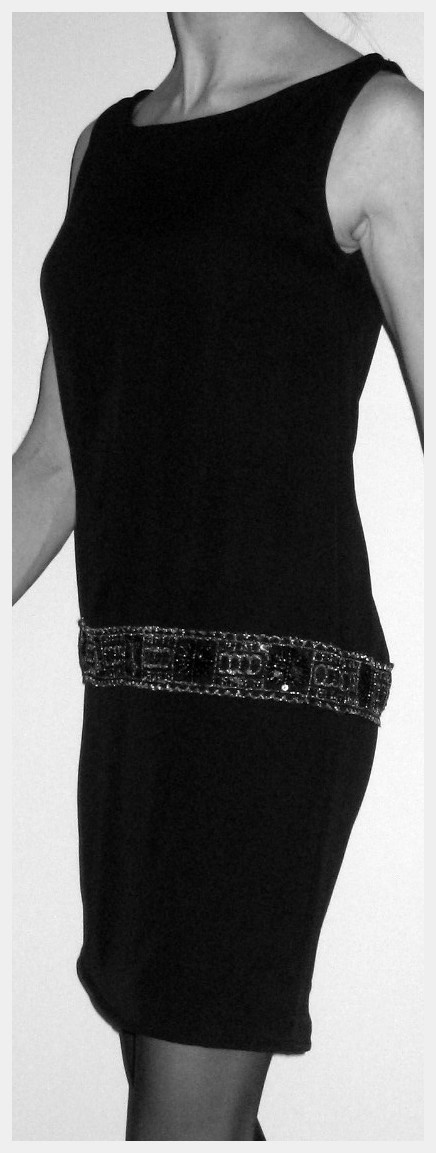
I chose to create my own version of one of the more modest dresses (I am in Kansas, after all!) Marilyn wore as Sugar Kane in Some Like It Hot. It was set in the twenties when drop-waists were the rage, so I included that feature in my design. The dress is simple, yet chic.


MADE IN KANSAS